
JEANNE’S REVIEW
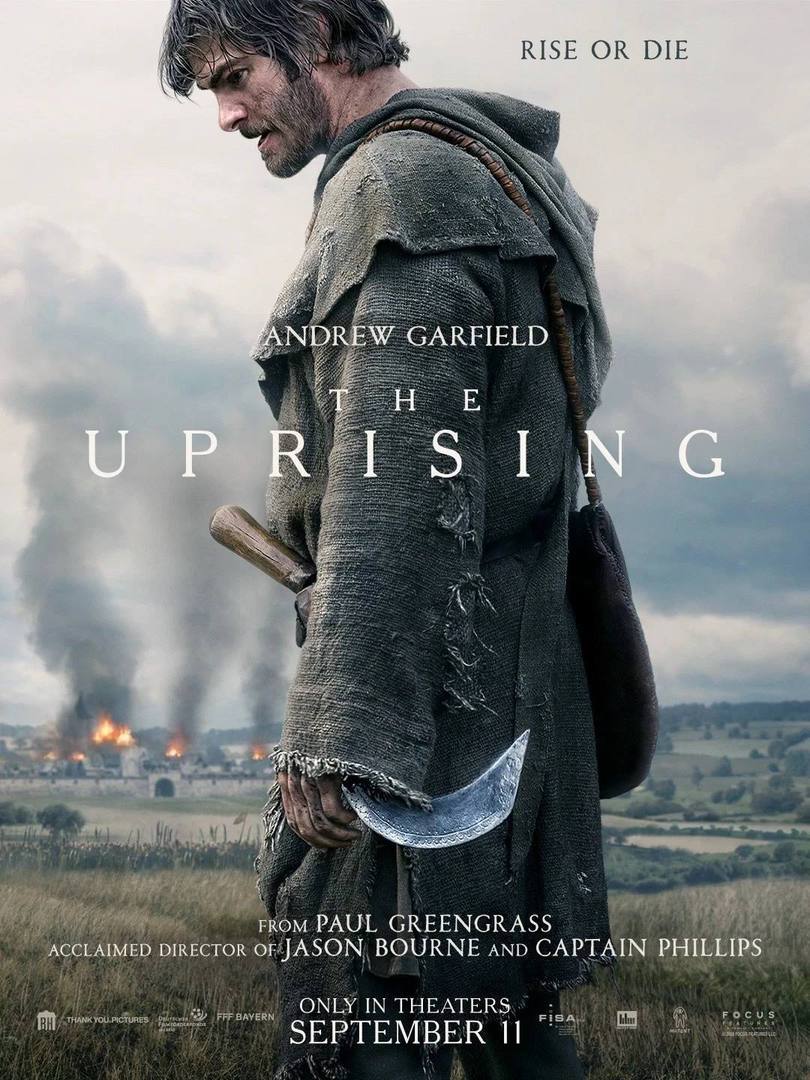
The Great Uprising, also known as the Peasants’ Revolt or Wat Tyler’s Rebellion historically began on May 31, 1381. For the past 50 years, the Plague or Black Death had ravaged England with half the population lost. Writer/director Paul Greengrass has brought this heroic event to life in his latest film, THE UPRISING.
While Greengrass does include the known organizers of this rebellion, he chooses to focus on a peasant, the Ploughman, played with admirable intensity by Andrew Garfield. His wife and child perished during the plague and he is left to plow his meager farm with his singular ox. When, once again, the common folk are being taxed more than they can bear, the Ploughman snaps and beats one of the King’s guards.
This most recent poll tax is the work of young King Richard II’s (Woody Norman) most trusted advisors. Only 14 years old at this time, his mother, the Countess (Katherine Waterston), implores her son to take an active part in his kingdom and listen to the oligarchs, Archbishop of Canterbury Simon Sudbury (Stephen Dillane), Treasurer Robert Hales (Tom Hollander), Chief Justice Belknap (Stanley Townsend) and Mayor William Walworth (Jonny Lee Miller).
After the Ploughman’s act of rebellion, he is enthusiastically embraced by Wat Tyler (Cosmo Jarvis), the peasant leader, and English priest, John Ball (Jamie Bell), who advocated for social changes. Another of Ball’s followers, Alyce (Thomasin McKenzie), provides a romantic interest for the Ploughman and was written by Greengrass as a representative of women in the movement.
In a matter of days, thousands march to London hoping to meet with the King for an opportunity to air their grievances and negotiate new demands. The King is sent by his court to meet the peasants and their leaders, and all seems to go as planned --- until it doesn’t.
Greengrass has penned an historic action adventure with a great many battles. But unlike a few films in recent memory, these fighting scenes are not overly prolonged. However, they are fairly violent, which, of course, would be emblematic of this period. He also has a gift for showcasing the dichotomy between the oligarchs and the peasants. Garfield’s character is perpetually covered in filth, as are the others on their crusade, while the King, the Countess and the court are resplendent in their finery.
Garfield is a masterful choice to portray the Ploughman. We witness his reluctance to act and to be a part of such an undertaking, but once he is convinced this is the right course of action, the Ploughman is all in. And Garfield is superb at allowing the Ploughman’s transformation to take place over the course of the movie.
As one would expect, Hollander, Dillane, Jarvis and Bell are outstanding. Miller, always a favorite, plays Mayor Walworth with all the required nastiness --- so good. And Waterston, along with McKenzie, are so completely expressive with just their faces that almost no dialogue is necessary.
But the most outstanding performance in THE UPRISING belongs to Norman as the child King. To carry this character from a pathetic coward to a steely maniac --- and back to a coward --- is awe-inspiring. It’s definitely a performance worthy of an Oscar nomination.
With amazing production designs by Nikolaj Danielsen and a glorious soundtrack by German composer Volker Bertelmann, THE UPRISING is another film that begs to be seen on the big screen. Though, at times, the dialogue was difficult to decipher, it is not a big enough distraction from Greengrass’ majestic effort.
OPINION: SEE IT NOW!
DAVID’S REVIEW
Based on actual events, THE UPRISING takes place in England 645 years ago in 1381 --- 50 years after the plague known as the Black Death claimed the lives of half of England’s population. Written and directed by acclaimed filmmaker Paul Greengrass, the parallels to today’s world are undeniable.
THE UPRISING begins with a simple farmer who calls himself Ploughman (Andrew Garfield) rebelling against the unfair taxation of the common people because the King’s treasury is woefully short of funds. Based on the Peasants Revolt of the 14th century, the film is at times gruesome with its extreme violence --- think beheadings --- but vengeance can be rewarding at any level. It can also be thrilling to behold as Greengrass immerses the viewer into the midst of the action.
This is a story about power begetting more power, and when those in control get greedy, the treachery knows no bounds. But when complacency sets in and the powerful are no longer paying attention --- the result is retribution. The actual events of this time are said to have inspired the legend of Robin Hood.
A quietly strong performance from Garfield anchors the fine cast, which also includes Woody Norman portraying the 14-year-old King Richard II, succeeding his deceased father. What initially looks like the folly of British tradition --- where family members assume positions of royalty --- proves not to be so ridiculous. The young King appears clueless in the early stages of his rule, relying on the supposed wisdom of his oligarch advisors. But Richard II is anything but clueless --- he actually turns out to be more cunning and malevolent than anyone could have foreseen. As good as Garfield’s turn is here, it is young Norman’s performance that steals the show. Katherine Waterston is brilliant as the Countess, Richard’s mother.
What ensues after the brutal murder of one of the peasant leaders is a story that is best described as intense. The score by German composer and Oscar winner Volker Bertelmann clearly adds to that, but the ensemble acting is immensely strong and effective. Cosmo Jarvis as Wat Tyler and Jamie Bell as John Ball are memorable as two of the organizers of the rebellion.
THE UPRISING was shot in southern Germany “in the middle of nowhere” as Greengrass puts it. And there is no doubt that its compelling nature draws us in while the townspeople seek justice for their inadequate and unjust way of life. The crowd scenes are spectacular, but they also make much of the dialogue difficult to understand. This is a minor complaint as we can easily grasp the gist of virtually every scene.
Greengrass’ film is rife with small but relevant details, as when the scribe (Sky Yang) records the demands of the rebellious leaders on paper scrolls. The actor actually learned calligraphy with a quill and it shows up as authentic on the screen. Fascinating stuff.
OPINION: SEE IT NOW!
 Print
Print